Minimalist vs Interactive Website Design: What Works Best in Auckland?
For Auckland businesses planning a new website or redesign, the question of Minimalist vs Interactive website Design is more than a visual preference. It affects...
Areesh Ishtiaq
May 18, 2026
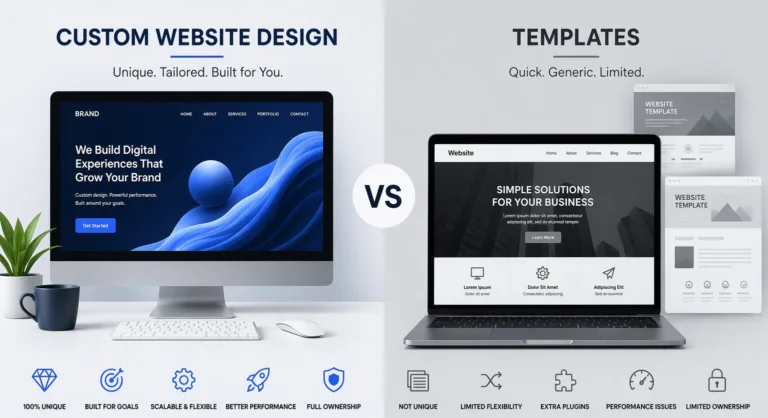
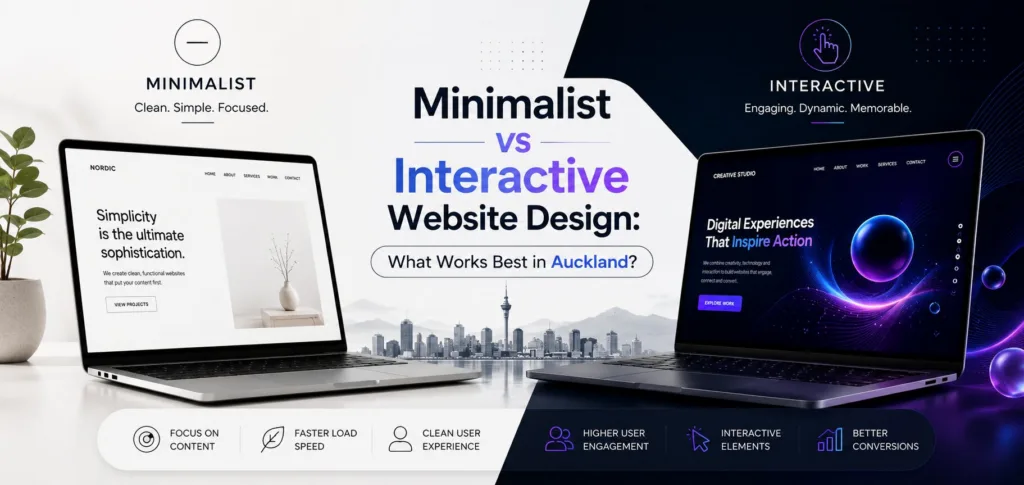
For Auckland businesses planning a new website or redesign, the question of Minimalist vs Interactive website Design is more than a visual preference. It affects how quickly visitors understand your offer, how confidently they move through your pages, and whether they take action before leaving. Minimalist vs Interactive website Design also plays a major role in shaping user experience, website speed, and overall engagement. Minimalist design prioritises clarity, white space, clean typography and focused calls to action, while interactive design uses motion, hover effects, scroll effects and dynamic content to create a more engaging digital experience.
The best option depends on your audience, industry and commercial goals. A law firm in Auckland Central may need a calm, credible and conversion-focused website that makes service information easy to scan. A creative studio, property brand or technology company may benefit from more interactive storytelling that demonstrates innovation. Current discussions around minimalist and interactive design consistently highlight clarity, user experience, mobile performance, page speed, engagement, conversion rate and trust as key decision factors.
Understanding Minimalist vs Interactive Website Design
A professional website should communicate value quickly. Whether the design is minimal or interactive, every layout choice should support the user journey. A strong Minimalist vs Interactive website Design strategy ensures visitors can navigate smoothly while staying engaged with the content. In practical terms, visitors should be able to understand who you are, what you offer and what to do next without confusion. This is particularly important in Auckland, where customers often compare multiple service providers before making an enquiry. Choosing the right balance in Minimalist vs Interactive website Design can significantly improve trust, usability, and conversion rates.
Minimalism and interactivity are not opposites in every situation. Many modern websites use a minimalist foundation with carefully selected interactive elements. This balanced approach reflects many of the Latest Website Design Trends, where clean layouts are enhanced with subtle motion, purposeful transitions and mobile-friendly interactions rather than overloaded effects.
What Minimalist Website Design Means
Minimalist website design is built around simplicity and focus. It normally uses generous white space, a limited colour palette, clear typography, simple navigation and concise content blocks. The purpose is not to make a website look empty; it is to remove anything that distracts visitors from the primary message and conversion path.
For service-based Auckland businesses, minimalism can make complex information feel more approachable. A consultant, accountant, builder or health provider may need pages that explain services clearly, prove credibility and guide visitors towards a quote, booking or phone call. In these cases, a clean design can reduce cognitive overload and make the website feel more trustworthy.
What Interactive Website Design Means
Interactive website design uses elements that respond to user behaviour. This can include hover states, animations, scroll-triggered transitions, interactive product demonstrations, accordions, quizzes, sliders, dynamic maps and motion-led storytelling. These features can help users explore content more actively and can make a brand feel modern, confident and memorable.
However, interaction must have a purpose. If animations slow the page, hide important information or make navigation harder, they can damage the user experience. Strong interactive design is not about adding movement everywhere. It is about using motion and responsiveness to support comprehension, encourage engagement and reinforce the brand experience.
Why Minimalist Design Works for Many Auckland Businesses
Minimalist design often works well because it aligns with how people browse websites. Users scan pages quickly, compare options and look for signals of relevance and trust. A simple page structure can help them find what they need before they lose interest. Research-led UX discussions repeatedly connect visual simplicity with improved clarity, information hierarchy and decision-making.
For many local businesses, minimalism also supports easier maintenance. A website with fewer heavy scripts, fewer unnecessary design layers and a cleaner content structure is often simpler to update. This matters when your services, team members, prices, suburbs served or case studies need regular changes.
Faster Loading and Cleaner Navigation
Minimalist websites are often lighter because they use fewer complex effects and unnecessary assets. While design style alone does not guarantee speed, a restrained layout can support better performance by reducing the number of large images, scripts and visual components that need to load. Faster pages can improve user satisfaction and reduce the chance of visitors abandoning the site before reading your offer.
Clean navigation is equally important. Auckland customers searching from a mobile phone may not want to work through complicated menus. They need direct paths to service pages, contact details, pricing guidance, testimonials and booking forms. Minimalist navigation helps users move with confidence.
Trust, Professionalism and Clear Messaging
Minimalist design can make a business look established, organised and credible. This is valuable for industries where trust matters, such as legal services, finance, construction, healthcare, real estate and professional consulting. The fewer distractions a visitor encounters, the easier it becomes to focus on expertise, proof and next steps.
“Minimalism works best when it turns attention towards the customer’s goal, not away from the brand’s personality.”
The strongest minimal websites still have character. They use brand colours, photography, copywriting and layout rhythm to create a polished impression without relying on unnecessary effects.
When Interactive Website Design Creates Better Results
Interactive design can be highly effective when a business needs to educate, demonstrate or inspire. Auckland companies in property, technology, design, tourism, hospitality and eCommerce may need more than static service blocks. They may need to show how something works, guide users through options or create a distinctive brand experience that visitors remember.
The key is intention. Interactive elements should improve the customer journey rather than distract from it. Motion can guide the eye, reveal information gradually, make complex ideas easier to understand and encourage deeper engagement.
Better Engagement for Creative and Product-Led Brands
Interactive design suits brands that sell experiences, products or ideas that benefit from visual demonstration. For example, a property development website might use interactive galleries, suburb maps and project timelines. A software company might use animated product walkthroughs. A design studio might use motion to show creativity and technical capability.
This approach can also improve time-on-site when visitors genuinely want to explore. However, engagement is only valuable when it supports a business goal. A visitor spending more time on a website is not automatically useful unless that time helps them understand, trust and act.
Storytelling, Motion and Micro-Interactions
Micro-interactions are small design responses such as button hover states, menu transitions, form confirmations or subtle scroll effects. They can make a website feel responsive and polished. When used carefully, they provide feedback and reassurance, helping users feel in control.
Storytelling is another strength of interactive design. Scroll-based sections, animated comparisons and progressive content reveals can lead visitors through a message step by step. This can be especially useful when explaining a complex offer or introducing a premium brand.
Design Approach
Best Suited To
Main Strength
Main Risk
Minimalist design
Professional services, local service providers, consultants and lead-generation websites
Clarity, speed, trust and simple conversion paths
Can feel plain if branding and copy are weak
Interactive design
Creative, technology, property, product-led and experience-based brands
Engagement, storytelling, brand memorability and demonstration
Can slow pages or distract users if overused
Balanced design
Most modern Auckland business websites
Clean structure with purposeful motion
Requires careful planning and testing
SEO, User Experience and Conversion Considerations
The debate around Minimalist vs Interactive website Design should always include SEO and conversion. Search performance depends on more than keywords; it is influenced by technical quality, mobile usability, page structure, content clarity and user satisfaction. A beautiful website that loads slowly, hides text behind effects or confuses mobile visitors may struggle to perform.
For Auckland businesses, local SEO also matters. Your website should clearly communicate services, locations, expertise and contact pathways. If you are investing in Website Design Auckland, the design should support both brand presentation and measurable search visibility.
Page Speed, Mobile Performance and SEO
Interactive features can increase file sizes, add scripts and affect loading if they are not optimised. This is why performance planning is essential. Images should be compressed, code should be clean, scripts should be limited and animations should be tested across mobile devices. Mobile-first thinking is critical because many New Zealand users browse, compare and enquire from smartphones.
Minimalist websites often have an advantage here, but interactive websites can also perform well when built properly. The goal is not to avoid all animation; it is to ensure that every feature earns its place.
Calls to Action and Lead Generation
A high-performing website needs clear calls to action. Minimalist design often makes CTAs more visible because there are fewer competing elements. Interactive design can also support lead generation by drawing attention to buttons, forms or consultation steps through subtle motion.
The best approach is to test how users respond. If visitors are not clicking, scrolling or enquiring, the issue may be poor content hierarchy, unclear value proposition, weak trust signals or an overloaded layout. Good design decisions should be supported by analytics, heatmaps, enquiry quality and conversion data.
Choosing the Right Approach for Your Industry
Different industries require different levels of simplicity, personality and interaction. A one-size-fits-all approach rarely works. An Auckland trades business may need fast service pages, strong calls to action and local proof. A boutique hotel may need immersive imagery and interactive booking pathways. A real estate agency may need property search tools, suburb guides and responsive galleries.
The right design style should reflect user intent. If visitors need quick answers, minimalism may perform best. If visitors need to explore, compare or experience a brand story, interactive design may add value.
Service Businesses and Professional Firms
Service businesses usually benefit from clarity. Lawyers, plumbers, accountants, electricians, consultants and healthcare providers need websites that quickly establish credibility and explain what happens next. Minimalist layouts can make phone numbers, enquiry forms, service categories and trust signals easier to find.
Interactive elements can still help, but they should be restrained. For example, service accordions, testimonial sliders and subtle form interactions can improve usability without overwhelming the visitor.
Retail, Real Estate and Creative Brands
Retail, real estate and creative brands often need richer visual experiences. Interactive product galleries, comparison tools, project showcases, video sections and animated storytelling can help visitors connect emotionally with the offer. In these sectors, a purely minimal website may not provide enough depth or differentiation.
The challenge is balance. The design must feel memorable while remaining fast, accessible and easy to navigate. Interactivity should never hide key information or create barriers for users on slower mobile connections.
The Best Answer: A Balanced, Purpose-Led Website
For most Auckland businesses, the best answer is not fully minimalist or heavily interactive. The strongest websites usually combine a clean foundation with carefully chosen interactive details. This gives users the clarity they need while still making the brand feel modern and engaging.
A purpose-led website begins with strategy. Before choosing design effects, define the audience, conversion goal, content hierarchy, mobile requirements and SEO priorities. Then decide where simplicity is essential and where interaction genuinely improves the experience.
Practical Checklist Before You Decide
Before committing to either approach, review the website from a customer’s point of view. Ask whether the page explains the offer quickly, whether the navigation is obvious, whether the CTA is visible, whether the design loads quickly on mobile and whether every interactive feature supports a real user need.
If the answer is unclear, simplify first. Add interaction only where it improves understanding, trust or conversion. This method prevents the website from becoming either too plain or too busy.
Final Recommendation for Auckland Businesses
If your business depends on trust, enquiries and clear communication, start with a minimalist structure. If your brand depends on experience, demonstration or visual storytelling, layer in purposeful interactive elements. For most businesses, the winning formula is a fast, mobile-friendly, SEO-aware website with clean content, polished branding and subtle interactions that guide users naturally.
Minimalist design gives your message room to breathe. Interactive design gives users reasons to engage. The best website uses both with discipline, ensuring that every section helps visitors understand your value and take the next step.


 Landing Pages