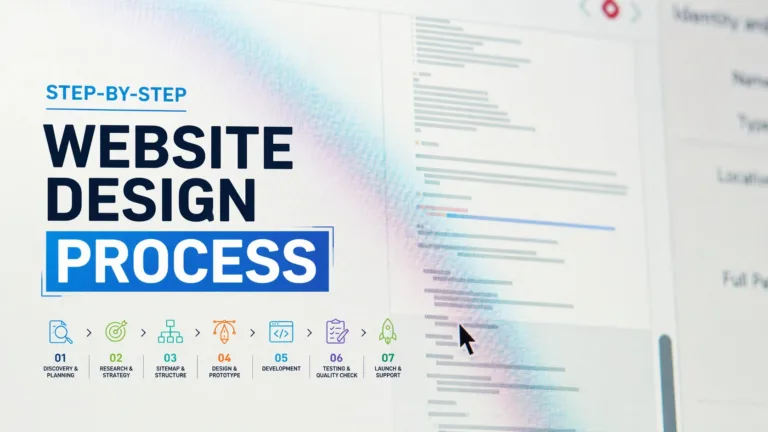
Understanding the Website Design Landscape
When New Zealand businesses embark on their digital journey, one of the most critical decisions they face is choosing between custom website design vs templates. This fundamental website design approach will shape not only the initial development process but also the long-term trajectory of their online presence. The choice between a custom website and a template website is far more than a simple technical decision; it represents a strategic commitment that affects everything from brand identity to business growth potential.
For businesses exploring Website Design Auckland, this decision becomes even more important due to the competitive local market and the need for a strong, distinctive online presence. The right approach can help Auckland-based companies stand out, attract local customers, and build long-term credibility.
For many organisations, understanding the differences between these two approaches is essential to making an informed website decision-making process that aligns with their unique business goals, target audience, and financial constraints.
“The right website platform isn’t just about what looks good today; it’s about what will support your business growth tomorrow.” – Digital Strategy Expert
What is Custom Website Design?
A custom website is built from the ground up, specifically tailored to meet the unique requirements of a business. Rather than adapting an existing framework, developers create a bespoke solution that incorporates the organisation’s specific functionality, design preferences, and business logic. This website development approach involves close collaboration between the business and the development team to ensure every element serves a purpose.
To better understand this approach, it helps to consider What Is Website Design in a broader sense—it’s not just about visuals, but about creating a fully functional digital experience that aligns with business objectives. A custom website design takes this concept further by offering complete control over every aspect of the site, from the underlying architecture to the user interface.
This level of customisation allows businesses to implement custom features and advanced functionality that are precisely aligned with their operational needs. This makes it an ideal approach for businesses investing in Auckland web design, especially when they require complex e-commerce capabilities, sophisticated data management systems, or industry-specific tools.
What is a Template Website?
A template website is built using pre-designed frameworks and structures that have been developed for general use. These templates provide a foundation upon which businesses can add their content, branding, and basic customisations. The template website approach significantly reduces development time and initial costs, making it an attractive option for startups and small businesses operating on tight budgets. However, this convenience comes with inherent website limitations and feature restrictions that may constrain how the site can evolve. Template websites typically offer a standardised set of features and design options, which means businesses must work within the confines of what the template provider has predetermined, rather than having the flexibility to create something entirely unique to their brand.
Comparing Custom and Template Websites
Understanding the nuances of custom vs template website approaches requires examining them across multiple dimensions. Each option presents distinct advantages and disadvantages that become apparent when evaluated against specific business needs and circumstances.
Website Flexibility and Customisation
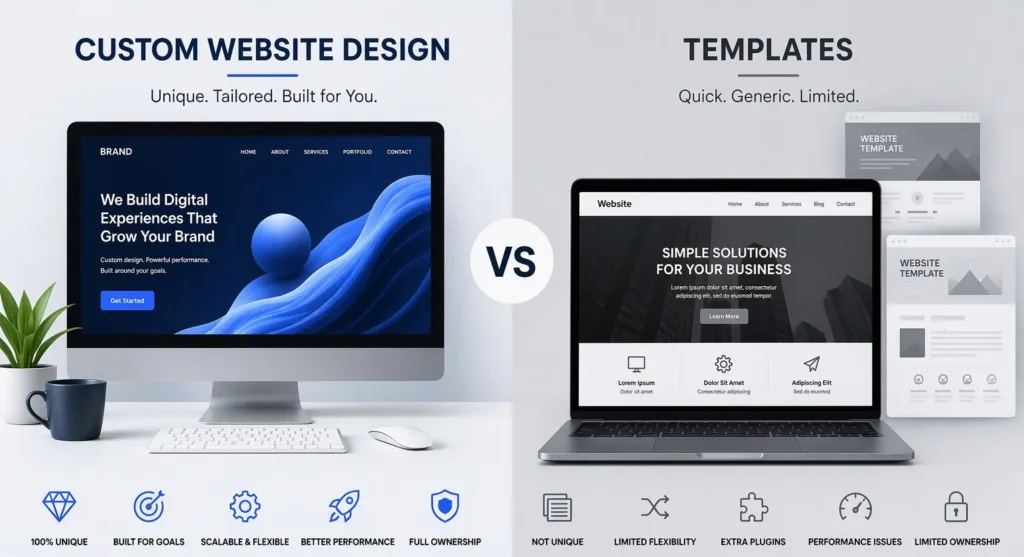
The most significant difference between a custom website and a template website lies in flexibility. A custom website design offers virtually unlimited flexibility, allowing developers to create exactly what the business envisions without compromise. Whether a company needs to integrate third-party applications, implement proprietary algorithms, or design an entirely unique user experience, custom development makes it possible. In contrast, template websites operate within predetermined boundaries. Whilst many templates offer customisation options, these are typically limited to colour schemes, fonts, and layout arrangements. When a business requires functionality that falls outside the template’s capabilities, they face a difficult choice: either compromise their vision or abandon the template altogether. For businesses with complex operational requirements or ambitious growth plans, this website flexibility becomes a critical factor in the website decision making process.
Website Uniqueness and Brand Identity
Every successful business possesses a distinct brand identity, and this uniqueness should be reflected in their digital presence. A custom website design enables businesses to create a truly distinctive unique design that sets them apart from competitors. This level of custom branding allows organisations to craft a visual identity that is entirely their own, creating a memorable brand experience for every visitor. The ability to implement personalised design elements—from custom animations to bespoke interactive features—helps businesses establish a stronger emotional connection with their audience. Template websites, whilst often visually appealing, inherently share design elements with countless other websites using the same template. This means a business using a popular template may find their site resembles their competitors’ sites, diluting their website uniqueness in the marketplace.
Website Functionality and Integration Capabilities
Modern businesses often rely on multiple software systems to manage their operations. A custom website can be seamlessly integrated with virtually any system a business uses, whether that’s a customer relationship management platform, inventory management system, or accounting software. Custom integrations and CRM integration capabilities enable businesses to create a unified digital ecosystem where data flows seamlessly between systems. This interconnectedness improves efficiency, reduces manual data entry, and provides valuable insights into customer behaviour. Template websites typically offer integration with popular third-party services, but this support is often limited. If a business uses specialised or niche software, they may find that their template website cannot integrate with it, forcing them to maintain separate systems and manual data transfer processes.
Making the Best Website Option Decision
Determining the best website option for your business requires careful consideration of your specific circumstances, goals, and resources. The website comparison between custom and template solutions is not about determining which is objectively superior; rather, it is about identifying which approach best serves your particular business strategy.
Assessing Your Business Website Strategy
Before committing to either approach, businesses must clearly define their business website strategy. This involves articulating what the website needs to accomplish, who the target audience is, and how the site will contribute to overall business objectives. A company with a straightforward website solution requirement—such as a professional services firm that primarily needs an online brochure and contact form—may find a template website perfectly adequate. Conversely, an e-commerce company with complex inventory management needs, multiple payment gateways, and personalised recommendation engines would benefit significantly from a custom website. The website strategy choice should be informed by a realistic assessment of current needs and anticipated future growth. A business that expects to expand its offerings, enter new markets, or significantly increase its customer base should consider whether a template will accommodate this growth or whether a custom website design would provide better scalability.
Evaluating Cost Considerations
The financial dimension of the custom vs template website decision is often the most immediately apparent. Upfront cost is typically much lower for template websites, making them a highly accessible option for new ventures. A custom website, by contrast, represents a substantial website investment, with development costs reflecting the bespoke nature of the work. However, the upfront cost is only part of the financial equation. Businesses must also consider long-term value and ROI (return on investment). A budget-friendly website template might seem attractive initially, but if it fails to generate leads, convert customers, or scale with the business, the overall cost-effective solution may prove to be false economy. A custom website design, whilst requiring higher initial development cost, may deliver superior returns through better user experience, improved conversion rates, and reduced maintenance cost over time due to optimised code and tailored functionality.
The Long-Term Implications of Your Choice
The decision between custom and template approaches extends far beyond the initial launch of your website. Understanding the long-term implications of this choice is essential for making a decision that will serve your business well into the future.
Scalability and Future Growth
One of the most critical considerations in the website decision making process is how well each option will support future growth. Template websites, whilst adequate for current needs, often struggle when businesses attempt to scale. As traffic increases, functionality expands, and integration requirements become more complex, the limitations of a template become increasingly apparent. A custom website, designed with scalability in mind, can grow alongside your business without requiring a complete rebuild. This adaptability is particularly valuable for businesses in dynamic industries or those with ambitious expansion plans. The ability to add new features, integrate additional systems, and optimise performance without architectural constraints provides a significant advantage for long-term success.
Choosing the Right Website Type
When it comes to choosing website type, there is no one-size-fits-all answer. The decision must be grounded in a thorough understanding of your business’s unique requirements, budget constraints, and long-term objectives.
“Your website is your most dedicated employee, working 24/7. Invest in it accordingly.” – Web Development Professional
By carefully evaluating the trade-offs between a custom website design vs templates, New Zealand businesses can make an informed choice that positions them for digital success. Whether you opt for the rapid deployment and lower initial cost of a template or the unparalleled flexibility and unique branding of a custom build, ensuring that your choice aligns with your overarching business strategy is the key to achieving a strong return on your digital investment.
Final Thoughts on Your Website Investment
Ultimately, the choice between custom website design vs templates depends on your specific circumstances, goals, and resources. For businesses seeking a quick, affordable online presence with straightforward requirements, a template website may be the ideal website solution. For organisations with complex needs, ambitious growth plans, or a strong emphasis on brand differentiation, a custom website represents a superior investment. The key is to approach this website decision making process with clarity about your business objectives and a realistic assessment of your needs. By carefully weighing the advantages and disadvantages of each approach, you can select the option that will best serve your business’s digital future in the competitive New Zealand market.


 Landing Pages