Case Study: Common Website Mistakes by NZ Businesses
In the modern New Zealand commercial landscape, your digital footprint is often the very first point of contact between your business and potential clients. A...
Areesh Ishtiaq
June 5, 2026
In the modern New Zealand commercial landscape, your digital footprint is often the very first point of contact between your business and potential clients. A business website is not just a digital placeholder; it should be your hardest-working salesperson and a highly efficient 24/7 salesperson, operating around the clock to represent your brand. However, when analyzing the digital footprint of various local enterprises, it becomes clear that many are leaving money on the table due to critical, yet easily avoidable, Common Website Mistakes.
Understanding Common Website Mistakes helps NZ businesses improve design, speed, mobile experience, and user journeys before potential customers leave. By identifying these Common Website Mistakes early, companies can create a more professional, conversion-focused website that supports stronger online growth.
Your website creates a crucial first impression of your business, and when it is an outdated website, a clunky website, or an unclear website, you are actively repelling visitors . This article explores the most common website mistakes, examines why they occur across NZ businesses and New Zealand businesses, and outlines how a smart website built with a conversion-focused design can transform your online presence .
1. Disregarding the Mobile-First Reality of Kiwi Traffic
One of the most pervasive website mistakes NZ businesses make is treating mobile optimization as an afterthought. Over 70% of NZ web traffic now originates from mobile devices, meaning that the mobile experience is the primary filter through which customers judge your brand .
When a site looks beautiful on a desktop but breaks on a phone, it erodes credibility instantly. Ignoring mobile users is no longer just a design oversight; it is a direct threat to your lead generation and customer acquisition efforts, resulting in losing leads .
Rethinking Layout, Flow, and Navigation for Mobile Devices
A truly mobile responsive website requires more than just scaling down desktop elements. A mobile-friendly design must rethink the entire website layout and website flow to accommodate a smaller screen layout . This includes implementing thumb-friendly navigation, where critical interactive elements are placed within easy reach of a user’s thumb . By optimizing the mobile experience, you ensure that your website’s content remains readable and accessible, preventing visitors from bouncing .
To capture mobile traffic effectively, your site must guide users toward a clear call to action without unnecessary steps. When navigation is cluttered or a form requires extensive manual typing on a small screen, mobile users will quickly abandon the process, hurting your overall lead generation . Optimizing the conversion path means ensuring that your website CTA—whether it is “Book a Free Consult” or “Shop Now”—is prominently displayed and easy to tap, turning casual mobile browsing into active customer enquiries .
2. Failing to Establish a Clear and Persuasive Conversion Flow
A beautiful design is completely useless if it does not guide visitors toward taking action. A cluttered homepage full of website jargon and long-winded mission statements acts as an immediate conversion killer .
Many NZ websites suffer from a complete lack of a strong call to action, burying their primary conversion goals under paragraphs of unnecessary text . If a visitor cannot figure out what you want them to do next within five seconds of landing on your homepage, you are losing leads .
The Danger of Competing, Scattered CTAs and Poor UX
Another common website layout mistake is scattering multiple, competing calls to action across a single page . When a user is presented with too many options—such as “Read Our Blog,” “Learn More,” and “Contact Us” all competing for attention—they suffer from decision fatigue .
To build a user-focused website and avoid poor UX, you must establish a clear conversion flow with a single, dominant homepage CTA and a clear call to action that guides the user journey toward your primary business goal . This prevents poor navigation and ensures visitors can easily find your pricing page, services page, and contact details .
Leveraging Local Success Stories as Trust Signals : Common Website Mistakes
To convert visitors, your site must establish immediate trust. Many New Zealand businesses leave out critical website trust signals, such as customer reviews, testimonials, brand logos, and case studies .
Integrating proof of success, clear guarantees, and a core message in plain language is essential to position your business as a trusted authority . By showcasing real-world website design success stories, you provide the social proof needed to overcome buyer hesitation and encourage visitors to take action .
3. Underestimating the Impact of Slow Load Times on UX and SEO
In the digital space, speed is a critical currency. Kiwi consumers expect instant gratification, and a slow-loading site will dramatically increase your website bounce rate .
Slow load times are not just a minor inconvenience; they are a major search engine ranking penalty. The Google algorithm prioritizes website performance as a core ranking factor, meaning a slow site will actively suppress your search visibility .
Resolving Technical Bottlenecks and Boosting Speed Performance
To eliminate website bottlenecks, businesses must prioritize website performance optimisation . Common culprits of slow website speed and page speed include uncompressed high-resolution images, bloated scripts, and poor hosting environments . Using tools like Google PageSpeed Insights and GTmetrix, a website strategist can identify exactly where your site is losing speed and implement solutions to compress images, reduce scripts, and migrate the site to a fast NZ server .
A fast website provides a smoother, more enjoyable user experience, which keeps visitors on your site longer . When you optimize your page speed, you create a seamless customer journey that encourages users to explore your services page, pricing page, and contact details . This technical refinement directly supports your search engine optimisation efforts, helping you rank higher on search results and capture more organic traffic .
Tool
Core Purpose
Key Metrics Measured
Google PageSpeed Insights
Performance Evaluation
Core Web Vitals, Largest Contentful Paint (LCP), First Input Delay (FID)
GTmetrix
Deep-Dive Technical Audit
Fully Loaded Time, Total Page Size, Number of Server Requests
4. Neglecting a Structured Search Engine Optimisation Strategy
Building a stunning website is only half the battle; people actually need to find it. A common website design mistake is launching a new site with no SEO strategy in place .
Many businesses treat search engine optimisation as a separate, optional add-on rather than integrating it into the core website structure from day one . Without proper keyword research, on-page SEO, and content optimisation, your website will remain invisible to search engines .
The Importance of Keyword Research, Structure, and Backlinks
Before writing a single line of copy, a digital agency must conduct rigorous keyword research using tools like Google Keyword Planner and Google Trends . This ensures that your site’s content is structured around the exact terms your potential customers are searching for . A search-optimized website structure uses logical URL paths, optimized meta tags, and structured headings to help search engines understand the relevance and prominence of your pages .
For local businesses, generic SEO is not enough. To capture high-intent local traffic, you must implement a localized website design strategy and build authoritative backlinks . This involves optimizing your content for geographic-specific keywords—such as “Website Design Auckland“—and ensuring your contact details and service area are clearly defined . By aligning your site’s structure with local search intent, you dramatically improve your search visibility and attract highly qualified local leads .
5. Falling into the Trap of DIY Platforms and Bloated Templates
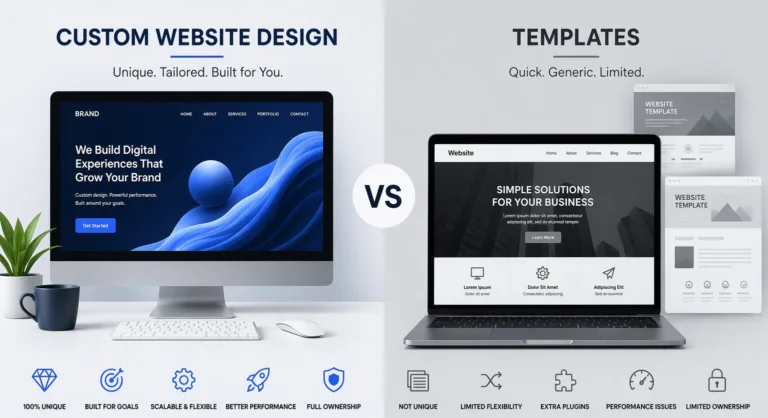
When starting out, many small businesses turn to DIY platforms like Wix websites or Squarespace websites to get online quickly . While these website templates offer a low-cost, immediate solution, they often lack the SEO structure, conversion flow, and performance needed for serious growth .
Behind the scenes, these DIY platforms and DIY websites can suffer from bloated code, poor mobile responsiveness, and limited customization options .
The Hidden Costs of Bloated Website Themes and Custom Builds
Even when using professional CMS platforms, many businesses make the mistake of using a bloated website theme . These templates often come packed with excessive, unnecessary features and scripts that slow down your page speed and create security vulnerabilities . Page builders like Elementor or Divi can bloat the code, leading to compatibility issues and unexpected errors during future updates .
For businesses aiming for serious growth, a custom WordPress website or a Webflow website is the superior choice . These platforms offer the flexibility to build a highly scalable website with clean code, custom UI/UX, and tailored user journeys . By investing in professional web design and development, you ensure your site can grow alongside your business and seamlessly integrate with advanced marketing tools, such as paid advertising, social media marketing, and email campaigns .
6. Treating Website Design as a Static, One-Off Project
A website is not a digital monument; it is a living, evolving business asset . One of the most common mistakes NZ businesses make is launching a website and then leaving it completely untouched for years .
Without ongoing optimisation and regular website optimisation, your site will slowly suffer from an outdated design that fails to reflect your on-brand design and visual identity .
The Necessity of Regular Performance Audits and User Testing
To maintain a high-performing website, businesses must establish a routine of monthly website check-ins or quarterly website check-ins . These sessions should be used to monitor site performance, review user behavior metrics, and identify potential website bottlenecks .
By conducting rigorous user testing and analyzing heatmaps, you can establish clear navigation, minimal navigation, and intuitive navigation . This data-driven refinement allows you to optimize your website navigation, content structure, and CTAs to continually improve website conversions .
Partnering for Long-Term Digital Success
If your current site is underperforming, it may be time for a comprehensive website audit or a complete website upgrade . To help you get started, we offer a free website audit to evaluate your current site performance and identify conversion opportunities .
Partnering with a professional digital marketing agency Auckland ensures that your site is built with a conversion-focused design, optimized for search, and designed to build for growth . By combining modern website design, localized website design, and expert search optimisation, you can transform your online presence and turn your website into your most powerful business asset .



 Landing Pages