 SEO
SEOYour Complete Guide to Google E-E-A-T for SEO Success in 2025
Google’s search algorithms are always changing, so anyone who wants to do SEO well needs to know what E-E-A-T means. This new framework adds Experience...
Read More

If you run a business in New Zealand and you have a Google Business Profile (GBP), there’s a good chance you set it up once,...

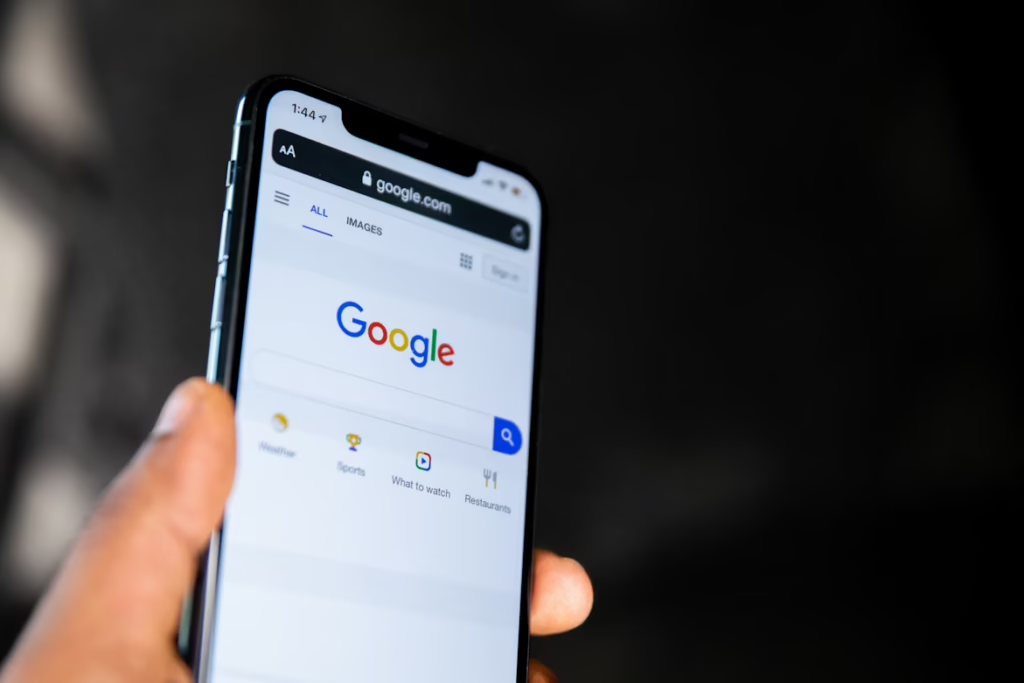
If you run a business in New Zealand and you have a Google Business Profile (GBP), there’s a good chance you set it up once, added your address and phone number, and then moved on. It sits there doing very little — and that’s a missed opportunity most of your competitors are making too.
Here’s the thing: your GBP listing is often the first thing a potential customer sees when they search for what you do. Before your website. Before any ad. Before a single blog post you’ve spent hours writing. And yet most businesses treat it as an afterthought.
In this post, we’re going to break down why GBP is one of the highest-leverage local SEO tools available — and what you should actually be doing with it.
When someone in Auckland types “accountant near me” or “plumber Christchurch” into Google, the results that appear in that map pack at the top of the page are entirely driven by GBP signals. Your standard website SEO — the blog posts, the backlinks, the on-page optimisation — plays a supporting role, but GBP is what gets you into that map pack.
Google uses three core factors to determine local rankings:
You can’t change distance. But relevance and prominence? Both are almost entirely within your control — and both start with what you put into your GBP.
Your primary category is one of the most important signals you send to Google. Be as specific as possible. “Marketing Agency” is weaker than “SEO Agency” if that’s genuinely what you do. You can add secondary categories too — use them to capture related searches without muddying your primary focus.
GBP lets you list your individual services with descriptions. Most businesses skip this entirely. Each service listing is a chance to include natural keyword language that reinforces what you offer. If you’re a web developer who also does e-commerce builds, create a separate service entry for it — don’t just lump everything under one vague heading.
Google Posts are essentially mini-blog updates that appear directly on your profile. They last seven days and then expire. Very few businesses use them consistently — which means the ones that do stand out. Regular posts signal to Google that your business is active, which contributes to prominence. Use them for offers, news, events, or simply to share useful tips relevant to your audience.
Profiles with photos receive significantly more direction requests and website clicks than those without. This isn’t just about looking good — it’s a behavioural signal that Google tracks. Upload genuine photos of your team, your workspace, your work in action. Stock photos won’t cut it here; authenticity wins.
Anyone can submit a question to your GBP — and anyone can answer it. If you haven’t checked this section recently, it’s worth looking now. You can proactively populate it with common questions your customers ask, using your answers to include relevant keyword language naturally.
Google reviews are arguably the single most impactful factor in local SEO after category selection. More reviews, higher average ratings, and recent activity all contribute to how prominently your profile ranks.
The most effective way to build reviews is simply to ask — directly, at the right moment. After a completed job, after a positive conversation, after a successful project delivery. Make it as easy as possible by sending a direct link to your GBP review page.
There are a few things to keep in mind:
One mistake we see often is businesses treating GBP and their website SEO as completely separate efforts. They’re not. They reinforce each other.
Your website’s domain authority, the consistency of your NAP (name, address, phone number) across the web, and the quality of your local citations all feed into how Google values your GBP. Similarly, a highly active, well-reviewed GBP profile generates trust signals that support your organic rankings beyond just the map pack.
This is why a proper local SEO strategy treats GBP optimisation and on-page SEO as two pillars of the same structure — not competing priorities.
Businesses that operate across multiple markets understand this well. For example, the team at SEO agency runs GBP optimisation as a core component of every client’s SEO programme — because rankings in any market, whether Auckland or Kuala Lumpur, follow the same fundamental principle: you need both the website and the profile working together.
If your address appears differently across your website, GBP, Facebook page, and directory listings — even minor differences like “St” vs “Street” — Google’s ability to verify your business location is weakened. Audit your citations for consistency.
Your GBP description is 750 characters of prime real estate. Most businesses write something like “We are a friendly, professional team dedicated to great service.” That tells Google almost nothing useful. Write a description that clearly explains what you do, where you operate, and who you help — using natural language that your customers would actually search.
If you’ve opened a new office or serve a new area, a separate GBP profile for that location is often worth the effort. Google’s local algorithm is geo-specific — a single profile for your head office will always underperform against a dedicated profile for the area where a customer is searching.
GBP allows customers to message you directly through the listing. Response time is tracked and displayed publicly. A fast response rate signals to both Google and prospective customers that you’re engaged and reliable.
Here’s a quick checklist you can run through right now:
If you ticked fewer than seven of those, your GBP is underperforming — and so is the local SEO that depends on it.
Google Business Profile is not a “set and forget” tool. It’s a living part of your local SEO strategy that rewards consistent attention. The businesses that show up first in the map pack aren’t just lucky — they’ve built a profile that signals relevance, activity, and trustworthiness to Google every single month.
If you’re not sure where your GBP stands, or you want help building a local SEO strategy that connects your profile to your broader website performance, get in touch with the i2d team — we’d love to help.
SEOGoogle’s search algorithms are always changing, so anyone who wants to do SEO well needs to know what E-E-A-T means. This new framework adds Experience...
Read More SEO
SEOYour online presence can be made or broken by the right SEO Auckland agency. There are hundreds of agencies that say they are the best....
Read More SEO
SEOMaking a beautiful website is only the first step. Without proper on-site SEO, even the most stunning designs remain invisible to potential customers searching online....
Read More