 SEO
SEOYour Complete Guide to Google E-E-A-T for SEO Success in 2025
Google’s search algorithms are always changing, so anyone who wants to do SEO well needs to know what E-E-A-T means. This new framework adds Experience...
Read More

Search Engine Optimization (SEO) for Auckland can often feel like a complex puzzle with constantly shifting pieces. You make a great website, but how do...


Search Engine Optimization (SEO) for Auckland can often feel like a complex puzzle with constantly shifting pieces. You make a great website, but how do you get people to see it? There are many things that can make your site more visible, but a business blog is one of the most powerful and reliable tools you have.
A blog is more than just a place to post company news; it’s a smart way to boost your SEO in Auckland on your own site. When you regularly post high-quality, relevant content, you send strong signals to search engines like Google that your site is active, trustworthy, and a useful resource for users. This guide will walk you through exactly how maintaining a blog can significantly boost your website’s search engine rankings and attract more organic traffic.
Keywords are the most important part of SEO. They are the terms and phrases people type into search engines. A blog is the best place to use these keywords in a way that feels natural and gives your readers something useful.
You don’t have to put keywords on your main service or product pages. Instead, you can write blog posts that answer questions or solve problems that are related to those keywords. If you sell cleaning supplies that are good for the environment, you could write posts like “How to Make Your Cleaning Routine Safe” or “5 Harmful Chemicals in Household Cleaners.”
This method lets you:
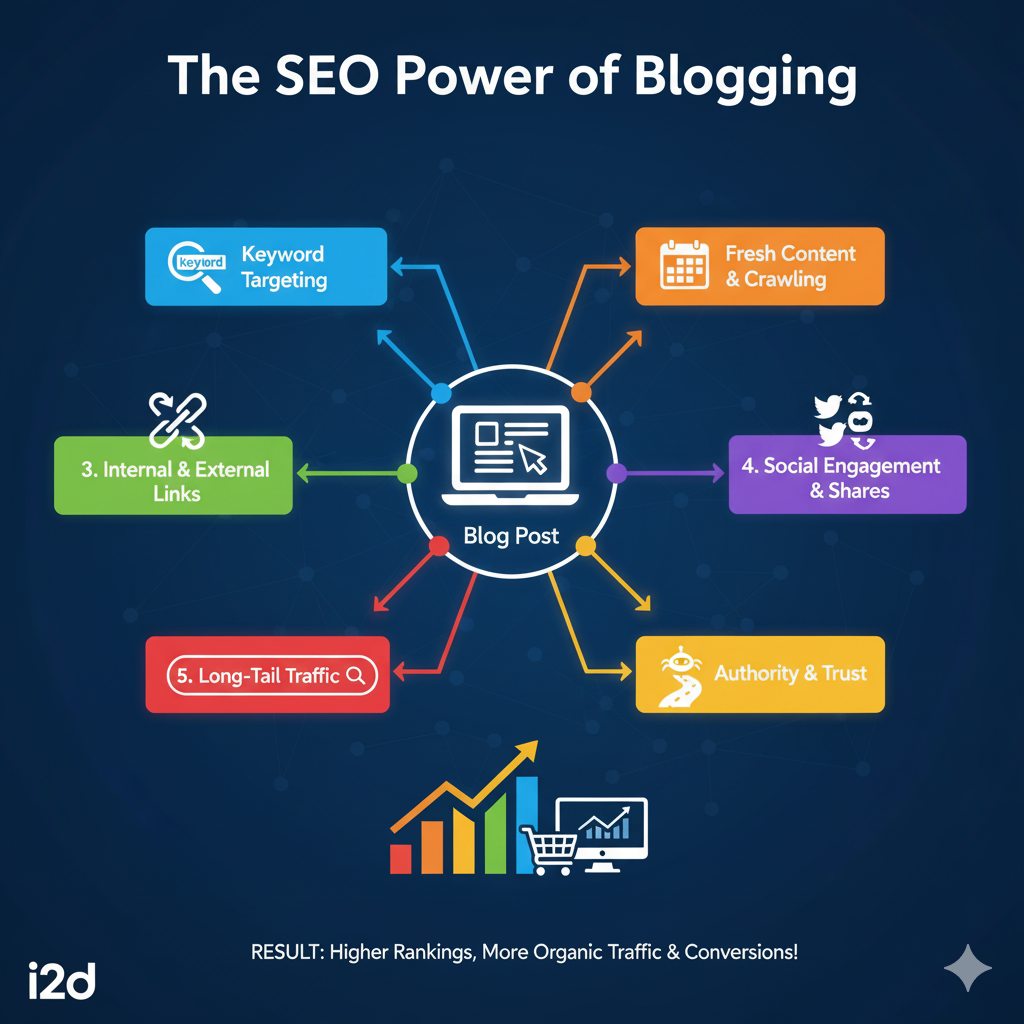
Search engines favor websites that are regularly updated. People may think that sites that haven’t changed in years are old or not useful. The best and easiest way to keep your website up to date is to add new content to it on a regular basis.
When you write a new blog post, search engine crawlers have a reason to come back to your site and index a new page. This regular activity shows that your website is still up and running and has up-to-date information. This newness can help your site’s overall authority and also in search engine optimisation for Auckland. If you set a regular schedule for your blog, like once a week, every other week, or once a month, you’ll always have new content that both users and search engines will like.
Hyperlinks that go from one page on your website to another are called internal links. For onsite SEO, a strong internal linking strategy is very important because it helps search engines figure out how your site is set up and how your pages are related to each other.
Blogs are a great way to build this structure. You can easily link to your important service or product pages as you make new content. For example, a company that sells athletic shoes can link to its product pages for certain shoe models in a blog post called “Tips for Choosing the Right Running Shoes.”
This method achieves a number of important SEO goals:
While linking within your own site is important, linking out to other reputable websites known as external or outbound links also plays a role in SEO. When you use reliable sources, you tell search engines that your content is well-researched and can be trusted.
You can think of it as a research paper. When you cite your sources, your arguments become more credible. Also, linking to reputable domains, such as government statistics, industry studies, or well-known news sites, can make your blog posts more credible. This tells Google that you are a trustworthy source of information, which can slowly boost the authority of your own site over time.

Search engines keep track of how people use your content. Time on page, comments, and social shares are all examples of indirect signals of content quality. Blogs are meant to be interesting and easy to share.
A good blog post can get people talking in the comments and make them want to share it on their social media profiles. When your content is shared, it creates backlinks from social platforms and potentially from other websites that discover it. Search engines see this higher visibility and traffic as a good sign that your content is useful to more people.
A long-tail keyword is a search term that is longer and more specific than a short-tail keyword. Even though they don’t get as many searches on their own, they usually have a higher conversion rate because they are used by people who are closer to making a choice. Examples include “best running shoes for flat feet” or “how to start a vegetable garden in a small apartment.”
On your main product or service pages, it can be hard to focus on these specific questions. But blog posts are the best way to go into detail about these niche topics. By creating content that answers very specific questions, you can attract highly qualified traffic that is more likely to be interested in what you offer. Over time, a library of blog posts targeting various long-tail keywords can add up to a significant amount of organic traffic.
A well-maintained blog is no longer a “nice-to-have” ; it’s a fundamental component of a successful onsite SEO strategy. You can effectively use keywords, keep your site fresh, build a strong linking structure, and get people interested in your site by regularly making useful content. Every post gives you a chance to improve your search engine rankings and get more people to visit your site.
Are you feeling overwhelmed by the thought of making a steady stream of SEO-friendly content? The people at i2d can help you make a content strategy that works. Let’s work together to build your website’s authority. Book a consultation with us.
SEOGoogle’s search algorithms are always changing, so anyone who wants to do SEO well needs to know what E-E-A-T means. This new framework adds Experience...
Read More SEO
SEOYour online presence can be made or broken by the right SEO Auckland agency. There are hundreds of agencies that say they are the best....
Read More SEO
SEOMaking a beautiful website is only the first step. Without proper on-site SEO, even the most stunning designs remain invisible to potential customers searching online....
Read More