 SEO
SEOYour Complete Guide to Google E-E-A-T for SEO Success in 2025
Google’s search algorithms are always changing, so anyone who wants to do SEO well needs to know what E-E-A-T means. This new framework adds Experience...
Read More

The landscape of digital marketing is undergoing a profound transformation, driven largely by the rapid advancement of artificial intelligence. As we navigate through 2026, the...

The landscape of digital marketing is undergoing a profound transformation, driven largely by the rapid advancement of artificial intelligence. As we navigate through 2026, the future of SEO is no longer a distant concept but a present reality. The integration of Artificial Intelligence in SEO has fundamentally altered how search engines operate, how content is created, and how businesses connect with their target audiences. This shift towards AI-based SEO requires a comprehensive understanding of new technologies and a willingness to adapt traditional strategies to meet the demands of modern search algorithms.
In this new era, achieving high search rankings is less about manipulating keywords and more about delivering genuine value through AI-driven search mechanisms. The search engine optimization evolution has moved from simple keyword matching to complex systems that understand context, intent, and user behaviour. For businesses looking to maintain their competitive edge, embracing these changes is essential. Whether you are managing a local business or a global enterprise, understanding how AI impacts search visibility is crucial for long-term success.

The journey of Artificial Intelligence in SEO has been marked by significant milestones that have reshaped the digital landscape. Initially, search engines relied on basic algorithms that matched user queries with exact keywords found on web pages. However, as the internet grew exponentially, these simplistic methods became inadequate for delivering relevant results. The introduction of machine learning in search marked a turning point, allowing search engines to learn from vast amounts of data and improve their accuracy over time.
Today, AI-powered search engines use sophisticated models to analyse not just the words in a query, but the underlying meaning and context. This evolution has led to a more intuitive and responsive search experience, where the focus is on providing the most relevant and useful information to the user. As these technologies continue to advance, the digital marketing transformation will only accelerate, requiring marketers to stay ahead of the curve and continuously refine their strategies.
The transition from basic algorithms to AI-driven search has been a gradual but profound process. Early search engines were easily manipulated by tactics like keyword stuffing and hidden text. To combat this, search engines began incorporating more complex search algorithms designed to identify and penalise manipulative practices while rewarding high-quality, relevant content. The integration of AI has taken this a step further, enabling search engines to understand the nuances of human language and deliver results that truly match the user’s intent.
Machine learning in search has become the backbone of modern search engines. By continuously analysing user interactions, click-through rates, and other behavioural signals, machine learning algorithms can identify patterns and adjust rankings accordingly. This means that search results are constantly evolving, becoming more accurate and personalised over time. For SEO professionals, this highlights the importance of focusing on user experience and creating content that genuinely satisfies the user’s needs, rather than simply trying to game the system.
To succeed in the current digital landscape, it is essential to understand how AI-powered search engines operate. These systems use a combination of natural language processing, machine learning, and complex algorithms to process queries and deliver results. Unlike traditional search engines, which relied heavily on exact keyword matches, AI-powered systems can understand synonyms, related concepts, and the overall context of a query. This allows them to provide more accurate and relevant results, even for complex or ambiguous searches.
The shift towards AI search models has also led to the rise of entity-based SEO and knowledge graphs. Instead of just looking at individual words, search engines now identify entities—people, places, concepts, and things—and understand the relationships between them. This semantic understanding enables search engines to provide richer, more informative results, such as instant answers and detailed knowledge panels.
The transformation of search algorithms has been driven by the need to provide better, more relevant results to users. Major algorithm updates have increasingly focused on rewarding high-quality content and penalising low-quality or spammy sites. With the integration of AI, these algorithms have become much more sophisticated, capable of analysing a wide range of factors, including content relevance, user engagement, and site authority. This means that SEO strategies must be holistic, focusing on all aspects of a website’s performance and user experience.
Semantic search and context-based ranking are at the forefront of the search engine optimization evolution. Semantic search involves understanding the intent and contextual meaning of search queries, rather than just matching keywords. This requires search engines to analyse the relationships between words and concepts, using natural language processing to interpret the user’s true intent. As a result, content must be comprehensive, well-structured, and highly relevant to the user’s needs in order to rank well in a semantic search environment.

Content optimization with AI represents a new era in digital marketing. AI tools are now capable of analysing vast amounts of data to identify trends, gaps, and opportunities in content creation. This allows marketers to develop highly targeted and effective content strategies. From automated keyword research to AI content generation, these tools are streamlining the content creation process and enabling marketers to produce higher quality content at scale.
However, while AI can assist in the creation process, the human element remains crucial. High-quality content creation requires a deep understanding of the target audience, their pain points, and their preferences. AI can provide the data and insights needed to inform this understanding, but it is up to human creators to craft compelling, engaging, and value-driven content that resonates with readers.
Establishing topic authority is a key component of modern SEO. Search engines favour websites that demonstrate expertise and authority on a particular subject. This requires the consistent production of high-quality content creation that covers a topic comprehensively. AI tools can help identify the subtopics and related concepts that need to be addressed to build this authority, ensuring that content is both relevant and comprehensive.
Generative AI in search and AI content generation are transforming how content is produced and consumed. These technologies can generate articles, summaries, and even code, significantly speeding up the content creation process. However, it is important to use these tools responsibly. Search engines are becoming increasingly adept at identifying AI-generated content, and they continue to prioritise content that offers unique insights and genuine value. Therefore, AI should be used to augment human creativity, not replace it.
Understanding and predicting user search behavior is essential for effective SEO. AI has made it possible to analyse vast amounts of data to identify patterns and trends in how users search for information. This predictive search trends analysis allows marketers to anticipate what users are looking for and create content that meets those needs before they even arise.
By leveraging user intent analysis, businesses can tailor their content to match the specific stage of the user’s journey. Whether a user is looking for general information, comparing products, or ready to make a purchase, understanding their search intent understanding ensures that the right content is delivered at the right time.
User intent analysis is critical for delivering personalized search results. AI algorithms analyse a user’s search history, location, and other contextual factors to determine their intent and provide the most relevant results. This personalization in search means that two users searching for the same term may receive different results based on their individual preferences and past behaviour. For marketers, this highlights the importance of creating diverse content that caters to different intents and audiences.
The rise of zero-click searches and instant answers presents a unique challenge for SEO professionals. As search engines become better at providing direct answers to user queries on the search results page, users are less likely to click through to individual websites. To navigate this, marketers must focus on answer engine optimization and ensure their content is structured in a way that makes it easy for search engines to extract and display as an instant answer.
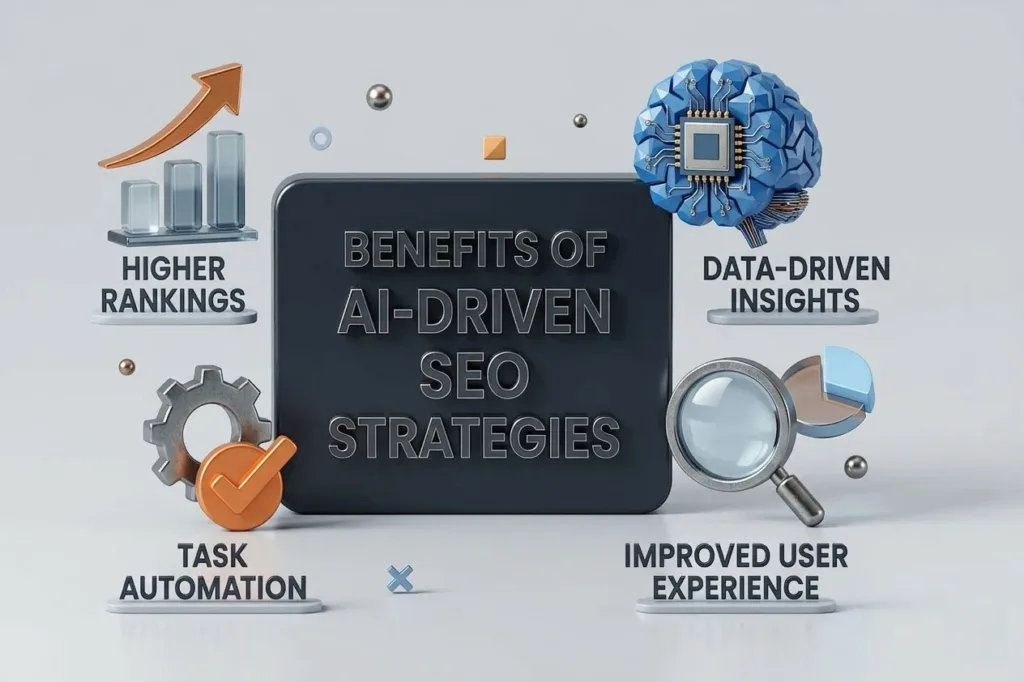
In 2026, data-driven SEO strategies are more important than ever. AI tools provide access to unprecedented amounts of data, allowing marketers to make informed decisions based on real-time insights. From automated keyword research to competitor analysis using AI, these tools are essential for developing effective and competitive SEO campaigns.
By leveraging data, businesses can identify new opportunities, optimise their existing content, and track their performance with greater accuracy. This data-driven approach ensures that SEO efforts are focused on the areas that will deliver the greatest return on investment, ultimately driving better results and improving online visibility.
Automated keyword research and competitor analysis using AI have revolutionised how marketers approach SEO. AI tools can quickly analyse vast amounts of data to identify high-value keywords and uncover competitor strategies. This allows businesses to identify gaps in the market and develop targeted campaigns that outperform their rivals. For businesses looking to dominate their local market, partnering with experts in SEO Auckland can provide the strategic advantage needed to succeed.
Building strong brand authority signals is crucial for improving online visibility. Search engines look for signals that indicate a brand is trustworthy and authoritative, such as high-quality backlinks, positive user reviews, and strong social media presence. AI tools can help monitor and manage these signals, ensuring that a brand maintains a positive reputation and strong presence across all digital channels.

The future of SEO lies in the human and AI collaboration. While AI provides powerful tools for data analysis, automation, and content generation, human creativity, empathy, and strategic thinking remain irreplaceable. An effective AI-first SEO strategy leverages the strengths of both, using AI to handle repetitive tasks and process large datasets, while humans focus on strategy, creativity, and building genuine connections with the audience.
This collaboration is essential for delivering a superior customer experience and achieving long-term success in digital marketing. By combining the analytical power of AI with human insight, businesses can create more engaging, relevant, and effective marketing campaigns.
Developing an AI-first SEO strategy is key to gaining a competitive advantage in 2026. This involves integrating AI tools into every aspect of the SEO process, from research and planning to execution and analysis. By embracing marketing automation and intelligent search systems, businesses can streamline their operations, improve their efficiency, and deliver better results.
Ultimately, the goal of SEO is not just to drive traffic, but to enhance the customer experience and drive conversions. Conversion optimization requires a deep understanding of user behaviour and preferences, which can be achieved through AI-enhanced user journey analysis. By delivering personalized search results and structured content that meets the user’s needs, businesses can improve engagement, build trust, and ultimately drive more conversions. The integration of conversational search queries and voice search optimization further enhances this experience, ensuring that users can find the information they need quickly and easily, regardless of how they choose to search.
SEOGoogle’s search algorithms are always changing, so anyone who wants to do SEO well needs to know what E-E-A-T means. This new framework adds Experience...
Read More SEO
SEOYour online presence can be made or broken by the right SEO Auckland agency. There are hundreds of agencies that say they are the best....
Read More SEO
SEOMaking a beautiful website is only the first step. Without proper on-site SEO, even the most stunning designs remain invisible to potential customers searching online....
Read More