 SEO
SEOYour Complete Guide to Google E-E-A-T for SEO Success in 2025
Google’s search algorithms are always changing, so anyone who wants to do SEO well needs to know what E-E-A-T means. This new framework adds Experience...
Read More

The digital landscape is in a constant state of flux, and for small businesses in New Zealand and across the globe, staying ahead of the...

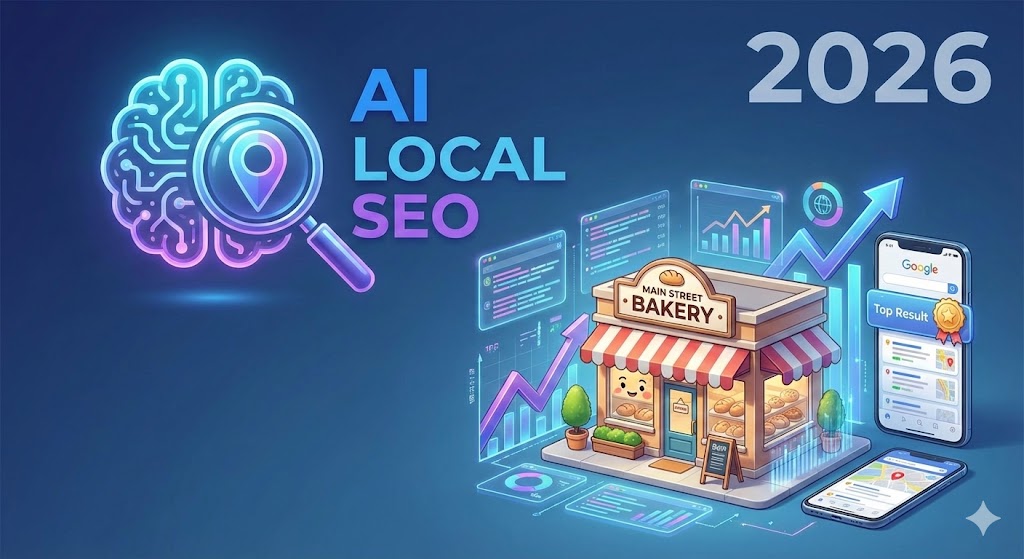
The digital landscape is in a constant state of flux, and for small businesses in New Zealand and across the globe, staying ahead of the curve is paramount. As we look towards 2026, the influence of artificial intelligence (AI) on local search engine optimisation (SEO) is undeniable. AI is no longer a futuristic concept; it’s a present-day reality that is reshaping how customers find local businesses. For small to medium-sized enterprises (SMEs), harnessing the power of AI in their local SEO strategy is not just an advantage—it’s essential for survival and growth. This article will explore how your business can leverage AI to dominate local search in 2026, covering everything from AI-driven tools to strategic implementation.
The way consumers search for local products and services is undergoing a radical transformation. Traditional search engines are increasingly incorporating AI, and the rise of AI-powered assistants and large language models (LLMs) like ChatGPT and Gemini is changing user behaviour. It’s projected that AI-powered assistants will handle roughly 25% of global search queries by 2026, leading to a significant drop in traditional search volume
Manual local SEO tactics are rapidly becoming obsolete. Monthly reports and a singular focus on Google are no longer sufficient to maintain visibility. AI search engines reward businesses that demonstrate consistent, verified authority across a multitude of platforms. A basic Google Business Profile and a few backlinks won’t cut it in this new era. AI demands daily signals, a strong cross-platform presence, and verified entity status to establish trust and authority. The traditional approach of updating listings once a month and hoping for the best is no longer viable in a landscape where AI systems are constantly scanning and evaluating business information across hundreds of platforms.
AI automation offers three critical advantages for local SEO: scalability, speed, and consistency. AI can automate routine tasks across countless locations simultaneously, ensuring that updates are propagated everywhere at once. This real-time optimisation replaces the slow, delayed updates of manual SEO, allowing businesses to react instantly to changes in reviews, operating hours, or new events. Furthermore, AI-driven systems generate daily cross-platform authority signals, which are crucial for building trust with modern AI models that verify businesses across the entire digital ecosystem. For businesses operating multiple locations or managing complex service areas, this level of automation is transformative.
To dominate local search in 2026, businesses must focus on building a robust and consistent digital footprint that is easily digestible by AI. This involves a multi-faceted approach that goes beyond traditional SEO practices. The foundation of this strategy is understanding that AI doesn’t just look at your website—it looks at your entire digital presence across all platforms where your business is mentioned or listed.
Maintaining consistent Name, Address, and Phone number (NAP) information across all online platforms is a cornerstone of local SEO. AI tools can automate this process, monitoring, detecting, and correcting errors instantly across Google Business Profile, Apple Maps, Bing, Yelp, and emerging AI directories. These tools offer real-time NAP scanning across over 100 platforms and allow for bulk updates to be executed in minutes, not days. This ensures perfect consistency, which has been shown to increase Google Business Profile views by as much as 42%
Online reviews are a powerful ranking factor and a key indicator of trust for both customers and AI. AI-powered review management tools can automatically solicit feedback from satisfied customers, analyse sentiment, and generate personalised, brand-aligned responses in real-time.

This is crucial, as businesses that maintain a high volume of positive reviews (e.g., 100+ reviews with a 4.5+ star rating) appear in 92% of AI search recommendations
In the age of AI, content remains king, but the rules of the game have changed. Generic, keyword-stuffed content will no longer suffice. Instead, businesses must focus on creating high-quality, hyperlocal content that demonstrates expertise, experience, authoritativeness, and trustworthiness (E-E-A-T). This shift reflects a broader trend in search where authenticity and genuine expertise are increasingly valued over volume and keyword density.
AI content systems can generate geo-targeted blog posts, FAQs, and event updates automatically. These tools can create locally relevant content with the proper schema markup, making it easily parseable by AI search platforms. This allows businesses to scale their content creation efforts and produce a steady stream of fresh, relevant content that appeals to both users and search engines. For businesses in competitive markets, such as those seeking to improve their SEO Auckland, leveraging AI for content creation can be a game-changer. The ability to quickly produce content that addresses local concerns, events, and interests gives small businesses a competitive edge.
Building authority in the age of AI requires a comprehensive approach that extends beyond traditional link building. Automated authority building tools can distribute your brand’s presence across Q&A platforms like Quora and Reddit, industry forums, and specialised directories. These systems syndicate content, create verified discussions, and generate entity signals that AI search engines use to establish trust and authority. This approach replaces the outdated backlink-only strategy with a more holistic method of entity verification. When AI systems see your business consistently mentioned and referenced across reputable platforms, they develop greater confidence in your expertise and reliability.
The transition to an AI-powered search landscape is already underway, and businesses that fail to adapt risk being left behind. By embracing AI-driven tools and strategies, small businesses can not only compete with larger corporations but also dominate their local search market.

The democratisation of AI tools means that even businesses with limited budgets can access sophisticated optimisation capabilities that were previously available only to large enterprises.
Your Google My Business (GMB) profile remains a critical component of your local SEO strategy. It is often the first impression a potential customer has of your business, and it is a key source of information for AI search engines. An optimised GMB profile, complete with accurate information, high-quality photos, and a steady stream of positive reviews, is essential for visibility in the local pack and on Google Maps. Beyond basic information, your GMB profile should be actively maintained with regular posts, updates about special offers, and responses to customer questions. This ongoing engagement signals to both Google and AI systems that your business is active and engaged with its community.
For many small businesses, navigating the complexities of AI-powered local SEO can be a daunting task. Partnering with the right local SEO companies can provide the expertise and resources needed to succeed. When choosing a local SEO partner, look for a company that has a deep understanding of AI and its impact on search, and that offers a comprehensive suite of services that includes automated listings management, review management, and hyperlocal content creation. The best local SEO companies will not only implement tools but also provide strategic guidance tailored to your specific business and market.
Implementing an AI-powered local SEO strategy requires a systematic approach. Here’s a step-by-step guide to get you started on your journey to dominating local search results.
Begin by conducting a comprehensive audit of your current digital footprint. Review your NAP consistency across all platforms, assess your review volume and sentiment, and examine your website’s schema markup for LLM compatibility. This will help you identify gaps and set clear priorities for your automation efforts. Understanding where you currently stand is essential before implementing any new strategies or tools.
Choose an automation platform that offers genuine automation, not just task reminders. Prioritise solutions with LLM-ready schema deployment, multi-platform review management, and real-time data synchronisation. Compare all-in-one suites versus specialised tools to find the best fit for your business needs. The right platform should integrate seamlessly with your existing systems and provide clear reporting on key metrics.
Structured data is crucial for helping AI systems understand your business information. Implement schema markup for your business type, including local business schema, review schema, and product or service schema. This makes it easier for AI crawlers to extract and understand your information, increasing the likelihood of your business being cited in AI-generated answers and recommendations.
Create a content calendar that focuses on hyperlocal topics relevant to your community. Use AI tools to identify trending topics and questions in your area, then create content that addresses these topics with genuine expertise and local insights. This content should be optimised for both traditional search and AI systems, with clear answers to common questions and actionable information for users.
As we move deeper into 2026 and beyond, the landscape will continue to evolve. Staying ahead requires a commitment to continuous learning and adaptation. Monitor changes in AI search platforms, track how your competitors are optimising for AI, and be willing to adjust your strategy accordingly. The businesses that will dominate local search are those that view AI not as a one-time implementation but as an ongoing evolution of their digital strategy.
The rise of AI is not a threat to small businesses; it’s an opportunity. By embracing AI-powered tools and strategies, you can level the playing field and compete with larger businesses on a more even footing. The key is to be proactive, to stay informed, and to be willing to adapt to the ever-changing digital landscape. By following the strategies outlined in this article, you can position your business for success and dominate local search in 2026 and beyond. The time to act is now—those who wait risk falling behind in an increasingly AI-driven search ecosystem.
SEOGoogle’s search algorithms are always changing, so anyone who wants to do SEO well needs to know what E-E-A-T means. This new framework adds Experience...
Read More SEO
SEOYour online presence can be made or broken by the right SEO Auckland agency. There are hundreds of agencies that say they are the best....
Read More SEO
SEOMaking a beautiful website is only the first step. Without proper on-site SEO, even the most stunning designs remain invisible to potential customers searching online....
Read More